

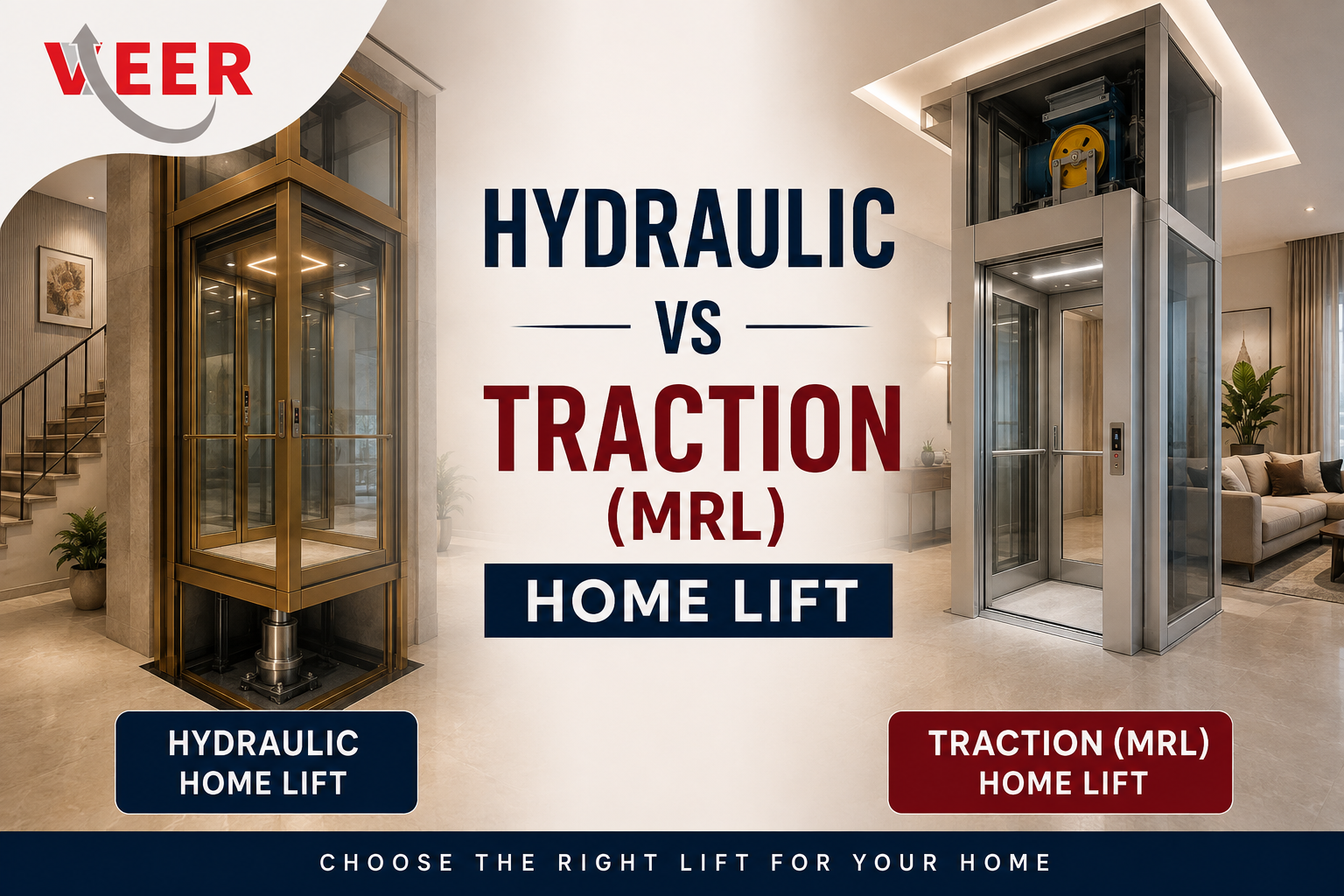
Making the right comparison between hydraulic and traction MRL home lifts comes down to one core question: do you value money now or money later? For a typical 2-4 floor Indian home, the choice mostly comes down to how you value money now vs. money later. A hydraulic lift costs less to install but runs up higher electricity bills and needs more frequent servicing. A traction MRL lift costs more upfront but saves on power, handles Indian power cuts better, and needs fewer repairs over 10+ years. If you plan to stay in the house long-term, traction MRL usually works out cheaper overall – even though it looks pricier on day one.
The key difference between the two lift types ultimately comes down to how each one moves the cabin – one uses fluid pressure, the other uses a counterweight – and that single design choice affects everything from your electricity bill to how the lift performs during a power cut.
Upfront Cost between Hydraulic Lift and Traction MRL Lift - What You Actually Pay
For a standard 2-4 floor home lift (4-6 person capacity), hydraulic lifts are typically cheaper to install because:
- The mechanism is simpler and uses fewer precision parts
- No overhead structural reinforcement is usually needed
- Installation labor and civil work are less specialized
Traction MRL lifts cost more upfront mainly because of the motor unit, rope/belt system, and counterweight assembly, plus the shaft needs slightly more precise overhead clearance. For a 2-4 floor home, expect the traction option to sit noticeably higher on the initial quote – but this gap matters less as floors increase, since traction systems scale more efficiently per floor.
Bottom line: If your budget is fixed and tight right now, hydraulic wins on Day 1.
Running Cost of Hydraulic Lift vs Traction MRL Lift Electricity Bills
This is where the two systems really diverge for Indian households.
- Hydraulic lifts use a motor and pump that has to push the entire cabin weight every single trip, both up and down. There’s no counterweight to help. For a family using the lift 15-20 times a day, this adds up on the monthly electricity bill.
- Traction MRL lifts use a counterweight that roughly balances the cabin’s weight, so the motor only has to manage the difference, not the full load. This can mean a noticeably lower per-trip power draw.
For a 2-4 floor home with moderate daily use, the difference may not feel dramatic month-to-month, but it compounds significantly over 10-15 years – traction MRL is the more power-efficient choice long-term.
Choose the Right Lift for Your 2-4 Floor Building
Whether hydraulic or traction is best for your building depends on budget, space, and usage. Talk to our lift experts and make the right decision.
Maintenance Frequency:
- Hydraulic lifts need periodic checks of hydraulic oil level, seals, and the pump unit. Oil can degrade or leak over years, especially in India’s temperature swings (hot summers can thin the oil, affecting ride smoothness). Servicing is usually simpler and can often be handled by local technicians, since the mechanism is mechanically straightforward.
- Traction MRL lifts have fewer fluid-related issues, but the rope/belt tension, motor unit, and control system need periodic professional checks. Since MRL technology is more specialized, you may need to rely on the original installer’s service team rather than a generic local technician, especially in smaller towns.
Practical takeaway: Hydraulic maintenance is more frequent but easier to source locally. Traction MRL maintenance is less frequent but may need a scheduled visit from a specialized technician.
Power Cut Performance:
Given how common power fluctuations still are in many parts of India, this is a genuinely important factor:
- Hydraulic lifts draw more power to operate, so if you’re running the lift on an inverter or generator during a cut, you’ll need a stronger (and costlier) backup system to support it comfortably.
- Traction MRL lifts draw less power per trip thanks to the counterweight, making them noticeably easier to run on a standard home inverter or a smaller backup system during outages.
If your area sees frequent power cuts and you don’t want to invest in a heavy-duty backup setup just for the lift, traction MRL is the more practical choice.
Noise Levels
- Hydraulic lifts have a pump that runs during operation, producing a low humming/motor noise, especially noticeable if the machine room is close to a bedroom or living area.
- Traction MRL lifts run quieter overall, since the motor is smaller and doesn’t need to generate hydraulic pressure – a relevant factor if the lift shaft is centrally located in the home.
Speed and Travel Height Limits:
- Hydraulic lifts typically move slower and are best suited to up to 4-5 floors. Beyond that, wait times and travel time start to feel noticeably longer, and the mechanism becomes less efficient.
- Traction MRL lifts move faster and comfortably handle taller homes (5+ floors) without a major drop in performance, making them more future-proof if you’re planning to add floors later.
For a strict 2-4 floor home, both types perform adequately on speed – this factor matters more if you’re planning future vertical expansion.
Long-Term Reliability:
- Hydraulic lifts generally have a working life of 15-20 years with regular servicing. The main wear points are the pump, seals, and hydraulic fluid system.
- Traction MRL lifts generally last 20-25 years, with the main wear points being the ropes/belts (which need periodic replacement) and the motor unit.
Over a 20-year ownership period, traction MRL lifts tend to need fewer major component replacements, while hydraulic systems may need oil-related servicing more often but rarely face catastrophic failure – both are considered reliable when installed and maintained properly.
Comparison of Hydraulic Lift and Traction MRL Lift (2-4 Floor Indian Homes)
Here’s a side-by-side breakdown of both lifts across every factor that actually matters for daily use:
Factor | Hydraulic Lift | Traction MRL Lift |
Upfront cost | Lower | Higher |
Running/electricity cost | Higher | Lower |
Maintenance frequency | More frequent, easier to source locally | Less frequent, needs specialized technician |
Annual Maintenance Contract (AMC) cost | Generally lower | Generally slightly higher |
Power cut performance | Needs stronger backup | Runs well on standard inverter |
Noise | Slightly more (pump noise) | Quieter |
Best travel height | Up to 4-5 floors | 5+ floors, more future-proof |
Long-term reliability | 15-20 years | 20-25 years |
Space required | Needs pit + small machine room | Compact, no separate machine room |
Ride comfort | Smooth but slightly slower response | Smoother start/stop, faster ride |
Ideal for | 2-4 floor homes, tight budgets | 3+ floor homes, long-term homeowners |
Repair technician availability | Widely available, even in smaller towns | Limited to trained/specialized technicians |
Suitability for future floor addition | Limited – not ideal beyond 4–5 floors | Well-suited, scales efficiently |
Resale/property value impact | Neutral to slightly positive | Slightly higher, seen as premium feature |
Which Lift Should You Choose for a 2-4 Floor Home?
Now that you’ve seen the full comparison between both lifts, here’s how to translate it into an actual decision:
Go with hydraulic if:
- You want the lowest possible installation cost right now
- You’re not planning to add floors in the future
- You’d rather rely on easily available local technicians for repairs
- Your area has stable power supply, so running cost is less of a concern
Go with traction MRL if:
- You can absorb a higher upfront cost for long-term savings
- You experience frequent power cuts and want easier backup power support
- You want a quieter lift, especially if it’s near living/sleeping areas
- You might add floors later and want a system that scales well
Frequently Asked Questions
1. What is the main difference between a hydraulic lift and a traction MRL lift?
2. Which home lift has lower electricity bills, hydraulic or traction MRL?
3. Which lift is easier to repair in smaller Indian towns?
4. Does a hydraulic lift work well during power cuts?
5. Is a traction MRL lift worth the extra cost for a 2-floor home?
6. How long does a home lift typically last?
Final Verdict
Weighing up both lifts side by side, the decision isn’t about which one is universally “better” – it’s about which one fits your situation. For most 2-4 floor Indian homes, if you’re budget-conscious right now and comfortable with slightly higher running costs, hydraulic is the practical pick. If you’re thinking long-term – lower bills, quieter operation, easier power-cut handling, and possible future floor additions – traction MRL pays off over time. The right call depends less on which lift is “technically better” and more on whether you’re optimizing for lower cost today or lower cost over the next 15–20 years.