

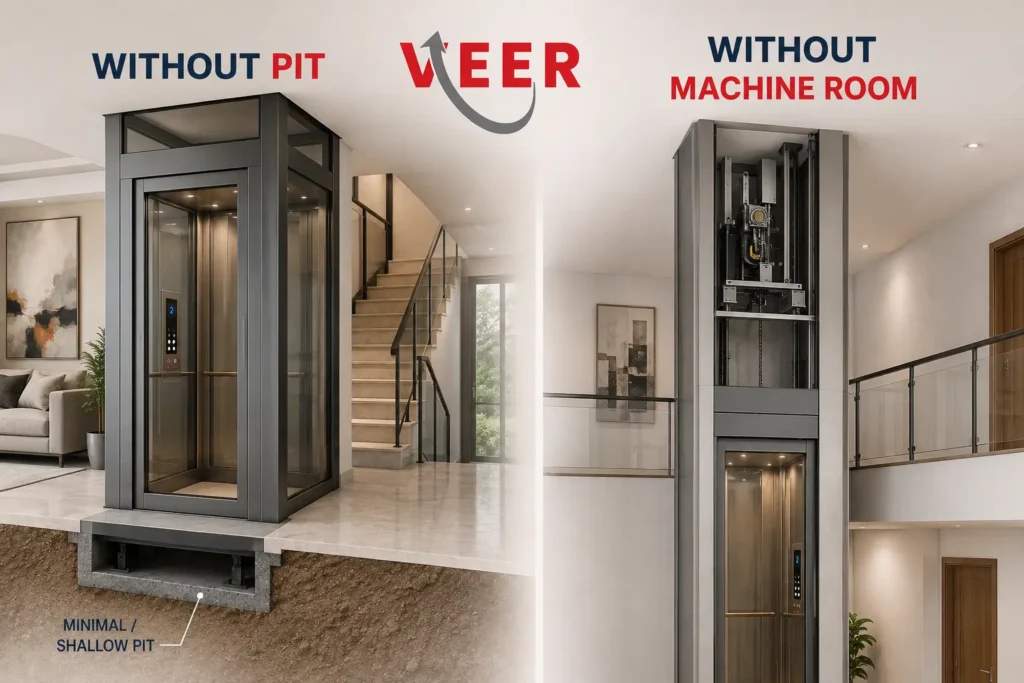
Adding an elevator used to mean digging a pit, building a separate machine room, and putting up with weeks of construction chaos. That’s no longer the case. Today’s home lifts without a pit or machine room let you add a fully functional, code-compliant elevator to almost any home – with little to no civil work, no floor cutting, and installation timelines measured in days, not months.
Whether you’re planning ahead for aging in place, helping a family member with limited mobility, or simply adding a luxury touch to a multi-storey home, a pitless, machine room-less lift is one of the easiest upgrades you can make. Here’s everything you need to know.
What is a Home Lift Without Pit or Machine Room?
A traditional elevator needs two things most homes don’t have: a pit (a recessed space below the lowest floor level where the lift car settles) and a machine room (a dedicated space, often on the roof or in a side closet, that houses the motor, pump, or drive system).
A pitless, machine room-less home lift eliminates both requirements by using a self-contained mechanism – typically hydraulic, vacuum/pneumatic, or a compact traction system – that’s built directly into the lift structure itself. The motor or pump sits within the shaft or cabin assembly rather than in a separate room, and the car can rest almost flush with the floor, needing only a shallow 3–6 inch recess (or sometimes none at all) instead of a multi-foot pit.
In short: no digging, no dedicated equipment room, and no major structural changes to your home.
Why Choose a Pitless, Machine Room-Less Elevator?
For most Indian homeowners, this style of lift solves the three biggest objections to installing an elevator:
No excavation or foundation work. You skip the pit digging, waterproofing, and structural reinforcement that traditional lifts demand.
No extra room lost to machinery. Every square foot of your home stays livable – there’s no roof-top plant room or utility closet eaten up by equipment.
Faster, cleaner installation. Less construction means less dust, less noise, and far less disruption to your daily routine.
It’s also simply more flexible. Because these lifts don’t rely on deep civil work, they can be retrofitted into existing homes that were never designed with an elevator in mind – something a conventional lift often can’t do without major renovation.
No Pit. No Machine Room. No Problem.
Heading: No Pit. No Machine Room. No Problem.
Body: Install a fully automatic home lift in your existing house — without any major civil work. Compact, safe, and ready to fit almost anywhere.
How Does It Work? (Hydraulic / Vacuum / Traction)
Pitless, machine room-less home lifts generally use one of three mechanisms:
Hydraulic lifts without a pit A compact hydraulic power pack (much smaller than commercial units) drives a piston that raises and lowers the car. The pump unit is housed within the lift’s own frame or a small adjacent cabinet, eliminating the need for a separate machine room while only requiring a shallow recess at the base.
Vacuum (pneumatic) home lifts These use air pressure differentials to move a cylindrical cabin up and down within a sealed tube. There’s no pit, no machine room, and no oil or hydraulic fluid involved – the entire mechanism is self-contained within the lift’s structure, making it one of the cleanest and most compact options available.
Compact/screw-drive traction systems A self-climbing screw or compact traction drive integrated into the shaft moves the car along a fixed column. Because the drive unit travels with the car or sits within the shaft itself, no separate motor room is needed.
Each system has its own trade-offs in speed, load capacity, ride comfort, and cost – worth discussing with a supplier based on your home’s layout and how many people or how much weight the lift needs to carry.
Installation Process: Minimal Civil Work, Maximum Convenience
One of the biggest draws of these lifts is how quickly they go in. A typical installation follows this sequence:
- Site survey and planning – A technician assesses the chosen location, ceiling height, and floor layout to confirm the lift will fit.
- Minor floor preparation – At most, a shallow recess (a few inches, not feet) is cut for the car to sit flush; many vacuum lifts need no recess at all.
- Structural assembly – The self-supporting shaft or enclosure (often glass, aluminum, or steel-framed) is assembled on-site, floor by floor.
- Mechanism and cabin fitting – The drive system and cabin are installed within the structure – no separate room required.
- Electrical connection and testing – The lift is wired to a standard power outlet or circuit and tested for safety and smoothness.
Many providers complete this entire process in 24-48 hours for a single-storey lift, with multi-floor installations taking a few days longer. Compare that to the weeks of masonry, waterproofing, and curing time a traditional lift pit demands.
Space Requirements & Dimensions
Because there’s no pit or machine room to plan around, the space you need to set aside is refreshingly simple:
- Footprint: Most compact home lifts fit within roughly 3 x 3 feet to 5 x 5 feet, depending on capacity (single-person vacuum lifts can be smaller; two-person or wheelchair-accessible models need more room).
- Headroom: A minimum overhead clearance of about 8-10 feet above the top landing is typically required, though this varies by model.
- Floor recess: Anywhere from zero to about 6 inches, versus the 3-6 feet a conventional lift pit requires.
- Placement flexibility: These lifts can often be positioned in a stairwell void, a corner of a room, near a balcony, or as an external add-on against an outside wall – locations a traditional lift usually can’t use.
This makes them a realistic option even for homes with tight floor plans or homes where a lift wasn’t part of the original architectural plan.
Safety Features in Modern Pitless Home Lifts
Skipping the pit and machine room doesn’t mean skipping on safety. Reputable home lifts – pit or no pit – typically include:
- Automatic emergency braking that engages if the car moves at an abnormal speed
- Battery backup / auto-lowering so the lift descends safely to the nearest floor during a power cut
- Door interlocks that prevent the lift from moving unless doors are fully closed
- Overload sensors that stop operation if weight limits are exceeded
- Emergency alarm and two-way communication for use if someone is stuck
- Fire-rated and shatter-resistant materials in the shaft and cabin construction
When evaluating a supplier, ask specifically which certifications and safety standards their lifts meet, and whether the model has been tested for residential use in India’s power and climate conditions.
Cost & Pricing in India
Pricing for a pitless, machine room-less home lift depends on the mechanism, capacity, number of floors, and finish level, but as a general guide for the Indian market:
- Basic single-person vacuum/pneumatic lifts: Entry-level pricing, ideal for single-storey use
- Two-person hydraulic or compact traction lifts: Mid-range pricing, suitable for most residential retrofit needs
- Premium/luxury finishes (glass shafts, designer cabins, higher capacity): Higher-end pricing for multi-floor or architecturally showcased installations
On top of the base unit, factor in installation charges, any minor civil work (even if minimal), electrical work, and an annual maintenance contract (AMC). Because there’s no pit excavation or machine room construction, the overall project cost is often noticeably lower than a traditional lift once civil work savings are factored in – even if the lift unit itself is comparably priced.
It’s worth getting a home visit and written quote from at least two or three suppliers, since site conditions (number of floors, structural access, power supply) can meaningfully affect the final price.
Top Brands Offering No-Pit Home Elevators
India’s home lift market has grown quickly, and several manufacturers – both domestic and international – now offer pitless, machine room-less models designed specifically for residential retrofits. When shortlisting a brand, look for:
- A track record of residential (not just commercial) installations in India
- Local service and spare parts availability in your city
- Clear certification and safety compliance documentation
- Transparent AMC (annual maintenance contract) terms
- Reference sites or client homes you can see in person or via video
Because this is a fast-evolving market with new entrants regularly, it’s worth checking current reviews and recent installation photos rather than relying on brand reputation alone.
Ideal For: Seniors, Luxury Homes, and Retrofits
This style of lift particularly suits:
- Senior-friendly homes – enabling aging in place without the stress and cost of a full home renovation, and reducing fall risk on stairs.
- Retrofit projects – older homes, independent houses, or duplexes that were never built with elevator shafts in mind.
- Luxury and premium residences – where a sleek glass-and-steel lift becomes a design feature as much as a convenience.
- Builders and architects – who can now offer “elevator-ready” homes without needing to reserve a pit and machine room in the original structural design, giving clients more flexibility to add a lift later.